

Every day on an American jobsite, tough tasks call for more than just skill—they demand reliable gear that works as hard as you do. For those in construction and the trades, choosing the right workwear means everything, especially when every hour exposes you to dirt, heavy lifting, and sudden weather. Find out how blue-collar workwear represents strength, pride, and a commitment to quality, all while giving you comfort and a look that fits your lifestyle both on and off the clock.
Table of Contents
- What Blue Collar Really Signifies
- Examples of Blue-Collar Jobs and Fields
- Why Blue-Collar Work Powers America
- Key Benefits and Government-Backed Pathways
- The Mindset and Pride of Blue-Collar Workers
Key Takeaways
| Point | Details |
|---|---|
| Understanding Blue-Collar Work | Blue-collar careers involve manual labor and skilled trades that are vital to the economy and offer tangible results. |
| Career Opportunities | Skilled trades provide stable job security and competitive wages, often exceeding those of traditional college graduates. |
| Pride in Craftsmanship | Blue-collar workers embody values of reliability and craftsmanship, taking pride in the direct impact of their work on society. |
| Government Support | The U.S. Department of Labor promotes apprenticeships and vocational training, offering pathways to well-paying blue-collar careers without significant debt. |
What Blue Collar Really Signifies
When people hear “blue collar,” they often picture someone in a hard hat swinging a wrench or standing on a construction site. But that’s just scratching the surface. The term holds deeper meaning than a stereotype or a job classification. A blue-collar worker performs manual labor or skilled trades across industries from construction and manufacturing to electrical work and carpentry. But what really matters is understanding the values, skill, and reliability behind the work itself.
The name itself carries history. The term originated because workers in manual labor traditionally wore blue denim or chambray shirts designed to hide dirt and grime from long, physical workdays. Over time, “blue collar” became shorthand for anyone engaged in hands-on work, hourly employment, and the working class. Today, it represents far more than the color of your shirt. It signifies a mindset of self-reliance, pride in craftsmanship, and the understanding that real work builds real things. When a carpenter finishes framing a house, when an electrician powers up a grid, when a welder fuses steel that holds a bridge together, they’re not just clocking hours. They’re creating the infrastructure that society depends on every single day.
The distinction between blue-collar and white-collar work typically centers on jobs requiring physical strength or skill versus office work. But this classification misses what makes blue-collar work truly significant. A skilled tradesperson doesn’t just perform labor; they master complex systems, solve problems on the fly, and take responsibility for outcomes that affect safety and livelihood. A plumber diagnosing a failing sewer line, a mechanic identifying an engine issue by sound and feel, a mason reading stone and mortar to build structures that last centuries, these professionals command knowledge that schools can’t teach in a classroom. The work is hands-on, yes, but it’s also strategic, technical, and deeply consequential.
What blue collar really signifies is this: the willingness to show up, work hard, develop real skills, and take pride in what you’ve built. It’s the badge of someone who understands that economy and strength come from producing things, fixing things, and maintaining the systems that keep communities functioning. Whether you’re laying electrical conduit in new construction, operating heavy machinery, managing a supply chain through trucking routes, or maintaining industrial equipment, blue-collar work carries the weight of responsibility and the reward of visible, tangible results. That’s what sets it apart.
Pro tip: Recognize that your blue-collar skill set has real market value; continuously invest in certifications or new trade skills to stay competitive and maximize your earning potential in a job market that desperately needs experienced hands.
Examples of Blue-Collar Jobs and Fields
Blue-collar work spans virtually every industry that keeps America running. When you look at the landscape of manual labor and skilled trades, the diversity of careers becomes immediately clear. Blue-collar workers perform manual labor across industries including construction, manufacturing, maintenance, and transportation. The range extends far beyond what many people realize, encompassing roles that require anything from basic training to years of specialized apprenticeship. Some positions are entry-level and serve as stepping stones into a trade, while others demand advanced certifications and command six-figure salaries. The common thread isn’t the specific job, but the hands-on nature of the work and the tangible value it creates.
Let’s look at specific fields where blue-collar professionals build their careers. Construction stands out as one of the largest employers, with roles including carpenters, ironworkers, concrete specialists, heavy equipment operators, and project supervisors managing entire builds from foundation to roof. Manufacturing brings together welders, machinists, CNC operators, and assembly line technicians who transform raw materials into finished products shipped worldwide. The electrical and plumbing trades require deep technical knowledge and problem-solving skills that can’t be rushed. Electricians wire buildings, troubleshoot complex systems, and ensure safety compliance. Plumbers maintain water and sewer systems that serve entire communities. Transportation and logistics employ truck drivers, heavy haulers, and equipment handlers who move goods across the country. Mechanics, whether automotive, diesel, or heavy equipment, diagnose problems and keep vehicles and machinery operational. HVAC technicians install and repair heating, cooling, and ventilation systems. Welders join metal structures for everything from skyscrapers to pipelines. Agricultural workers, miners, factory workers, and maintenance technicians across countless facilities round out the picture of blue-collar employment.
What makes these jobs particularly valuable is the demand that shows no signs of slowing down. Skilled labor occupations vital for building and maintaining essential infrastructure and services span construction, manufacturing, transportation, and agriculture. Unlike many office positions that can be automated or outsourced, blue-collar work remains locally dependent and irreplaceable. You can’t outsource electrical work or welding to another country when the job is happening on your street. This creates consistent job security and competitive wages. Many skilled trades start at apprenticeships where workers earn while they learn, gaining practical experience and industry certifications without accumulating student debt. A welder fresh out of apprenticeship can earn $40,000 to $50,000 annually, with experienced welders commanding $70,000 or more. Electricians and plumbers often run their own businesses after establishing themselves, creating unlimited earning potential through entrepreneurship.
The reality is this: blue-collar jobs aren’t just employment options; they’re career pathways that offer stability, good income, and the satisfaction of doing work that directly impacts people’s lives. Whether you’re drawn to working with your hands, solving mechanical problems, building structures, or maintaining critical systems, blue-collar fields offer opportunities that match virtually any interest and skill level. The shortage of skilled tradespeople means employers actively recruit workers and offer competitive benefits, job security, and advancement opportunities. For those considering a career in trades, the timing has never been better.
Here’s a summary of key blue-collar fields and the specialized skills they require:
| Field | Specialized Skill Needed | Typical Work Environment |
|---|---|---|
| Construction | Blueprint reading, equipment use | Outdoor, variable conditions |
| Manufacturing | Machine operation, precision | Factory or production floor |
| Electrical | Wiring, safety codes | Homes, businesses, sites |
| Plumbing | System diagnostics, repair | Residences, municipalities |
| Transportation | Logistics, vehicle operation | On the road, warehouses |
| HVAC | System maintenance, compliance | Commercial/residential sites |
| Welding | Metal joining, blueprint reading | Industrial, shipyards |
| Mechanical | Troubleshooting, repair | Garages, industrial plants |
Pro tip: Explore apprenticeship programs in your area through the Department of Labor’s Apprenticeship.gov platform; most trades offer paid training that lets you earn while you develop credentials that lead to strong earning potential.
Why Blue-Collar Work Powers America
Take a moment and look around any American city. The roads you drive on, the buildings you enter, the electricity flowing through walls, the water running from your tap, the products shipped to stores, the equipment keeping factories running. None of it exists without blue-collar workers. Blue-collar workers form the backbone of the American economy, contributing to manufacturing, construction, transportation, and agriculture. These aren’t just jobs; they’re the foundation upon which economic stability, growth, and daily life depend. When you strip away the abstract theories about economics, you find skilled trades and manual labor doing the actual work that generates real value, creates tangible products, and maintains the systems every single person relies on.
The economic impact runs deeper than most people realize. Every construction project that breaks ground requires electricians, welders, concrete specialists, and equipment operators working in coordination. Every manufacturing facility producing goods for domestic and global markets depends on machinists, welders, assembly technicians, and maintenance professionals keeping machines running. Every supply chain moving products across the country needs truck drivers, logistics coordinators, and warehouse workers. Every home and business needs plumbers, HVAC technicians, and electricians for maintenance and repairs. These aren’t peripheral roles; they’re central to productivity and profitability. Blue-collar jobs remain vital despite automation, with many roles requiring dexterity and technical skills harder to automate, leading to rising demand and competitive wages. Unlike many positions that can be outsourced or replaced by technology, skilled trades and hands-on work create a resilient economic foundation that can’t be shipped overseas or eliminated by software.
What makes blue-collar work truly powerful is its multiplier effect on communities. When a skilled tradesperson earns strong wages, they spend money locally. They buy homes, which stimulates construction and real estate markets. They pay taxes that fund schools and infrastructure. They support local businesses and restaurants. A single electrician completing industrial work might earn $70,000 to $100,000 annually, directly supporting their family’s economic security while contributing meaningfully to their community’s tax base. A construction crew building a commercial complex creates temporary jobs, supports suppliers, and generates economic activity that ripples through the region. Manufacturing workers produce goods that compete globally, bringing revenue into their regions and establishing competitive advantages in the worldwide marketplace. The skilled trades aren’t just moving money around; they’re creating it through the production of real goods and the maintenance of critical systems.
Beyond economics, blue-collar work powers America by solving real problems that society depends on. During infrastructure crises, it’s electricians and engineers restoring power. During supply chain disruptions, it’s truck drivers and logistics workers moving goods. When weather damages homes, it’s construction professionals rebuilding. When equipment fails, it’s mechanics diagnosing and fixing. The reliability and problem-solving capability of skilled tradespeople keep communities functioning and resilient. In an increasingly competitive global economy, American blue-collar workers provide a distinct advantage through their expertise, work ethic, and the quality they deliver. That competitive edge is what keeps American manufacturing relevant and allows American companies to compete successfully in worldwide markets.
Pro tip: If you’re considering trades as a career, recognize that you’re not just seeking a job but joining a workforce that literally powers the nation’s economy; this perspective can fuel your commitment to mastering your craft and building long-term earning potential.
Key Benefits and Government-Backed Pathways
Choosing a blue-collar career path offers tangible advantages that many people overlook when comparing it to traditional four-year college degrees. The most immediate benefit is financial: you start earning real money while learning your trade instead of accumulating six figures in student debt. Educational pathways such as vocational training and apprenticeships provide cost-effective routes compared to traditional college degrees, offering quick financial independence without student debt. An apprentice in the electrical trade, for example, might earn $15 to $20 per hour while learning on the job, gradually increasing as skills develop. By the time peers with college degrees are graduating and starting entry-level positions, an apprentice has already completed their training, earned thousands of dollars, and is commanding $50,000 or more annually with minimal debt. The math is straightforward: paid training beats unpaid education plus six-figure loans every single time.
Beyond the financial advantage, blue-collar careers offer job security and stability that white-collar positions often cannot match. Skilled trades remain in high demand because the work is locally dependent and cannot be automated or outsourced. When economic downturns occur, companies still need electricians to maintain facilities, plumbers to fix broken systems, and mechanics to keep equipment operational. This creates a recession-resistant foundation for your career. Additionally, skilled trades offer clear pathways to entrepreneurship. Many electricians, plumbers, and construction professionals transition from working for employers to running their own businesses, creating unlimited earning potential. A successful contractor managing multiple job sites can earn $150,000 to $300,000 annually or more. The skills you develop become transferable assets that support business ownership in ways that traditional office positions rarely do.
The table below compares blue-collar and white-collar careers in several key dimensions:
| Factor | Blue-Collar Career | White-Collar Career |
|---|---|---|
| Entry Path | Apprenticeship, vocational school | Four-year college degree |
| Education Cost | Low, often paid training | High, student loan common |
| Job Security | High, local hands-on demand | Varies, may face outsourcing |
| Advancement Track | Experience and certifications | Formal promotion structure |
| Entrepreneurship | Common in trades | Less common, more barriers |
The government recognizes the importance of skilled trades and has invested significantly in supporting educational pathways. The U.S. Department of Labor administers the Registered Apprenticeship program, which connects job seekers with paid training opportunities across hundreds of occupations. Through Apprenticeship.gov, you can search for programs in your area, connect with employers actively recruiting apprentices, and access information about wages, training length, and career progression. These registered apprenticeships are structured partnerships between employers and training providers, meaning the training is directly aligned with real industry needs. Many states offer additional incentives, including tuition assistance, equipment stipends, and tax credits for employers who invest in apprenticeships. Community colleges across America provide vocational training programs in welding, HVAC, electrical work, plumbing, and dozens of other trades, often with flexible scheduling and financial aid available. These programs range from six months to two years, making career entry much faster than traditional degree pathways.
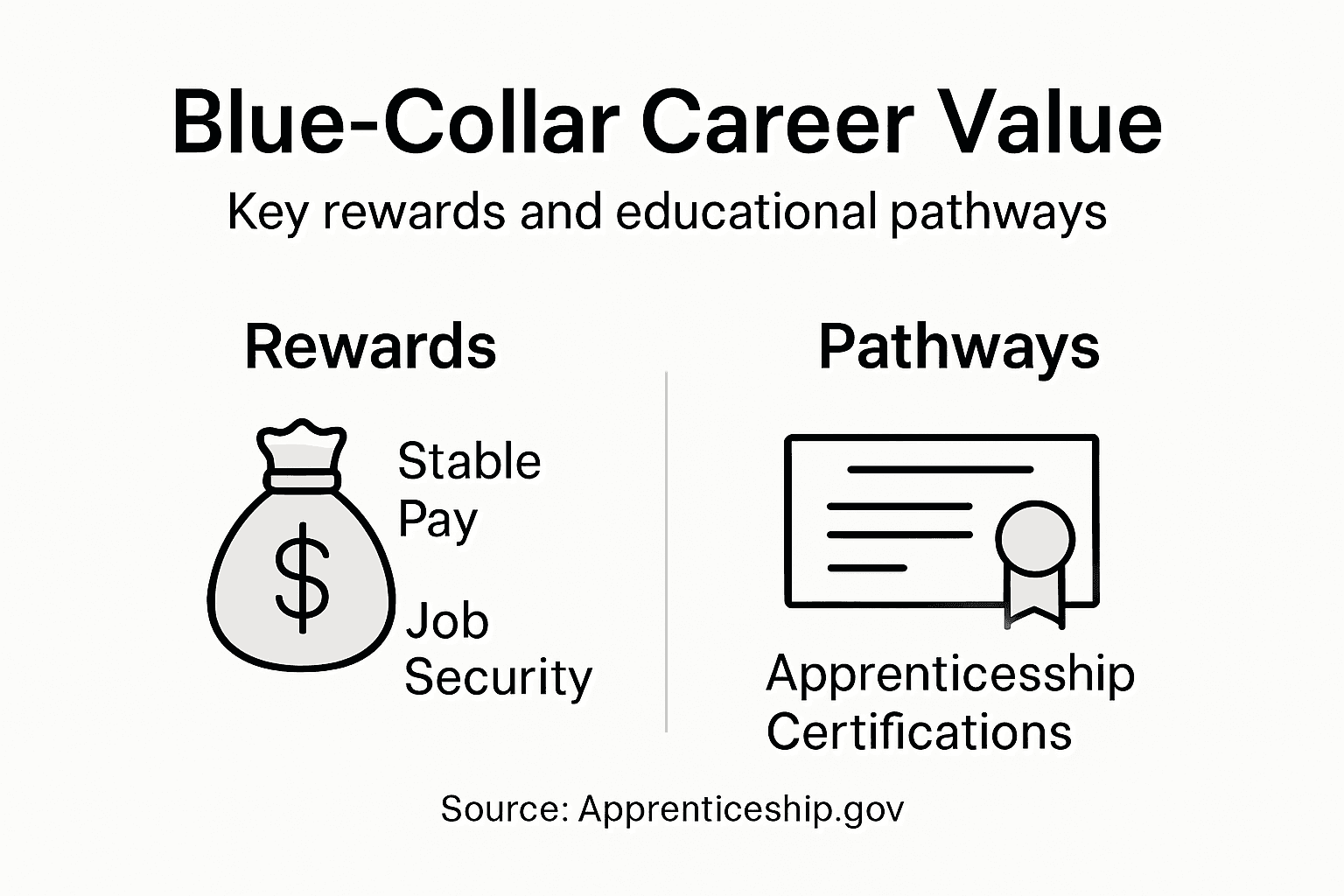
Another critical benefit is the skills you develop that extend beyond your specific trade. Blue-collar workers learn problem-solving, precision, safety protocols, time management, and teamwork through hands-on experience. These competencies are valued across industries and support career transitions if your interests evolve. The demand for skilled tradespeople shows no signs of slowing. Industry projections estimate shortages of electricians, plumbers, welders, and HVAC technicians for decades, meaning employers actively compete to recruit and retain qualified workers. This competition drives wages upward and creates negotiating power in your favor. Employers offer competitive benefits, flexible scheduling, hazard pay, and other incentives to attract skilled workers. The combination of government-supported educational pathways, strong market demand, clear earning trajectories, and entrepreneurial opportunities creates a compelling case for blue-collar careers as a legitimate and rewarding choice.
Pro tip: Start your search at Apprenticeship.gov and filter by your state and desired trade to see real job openings with specific wage information and training timelines; reach out directly to local employers to express interest before positions fill.
The Mindset and Pride of Blue-Collar Workers
There’s something fundamentally different about how blue-collar workers approach their jobs. It’s not about climbing corporate ladders or accumulating titles. It’s about showing up, doing the work right, and building a reputation you can stand behind. The mindset of blue-collar workers reflects values of dignity, independence, humility, and usefulness, rooted in self-reliance and craftsmanship. This isn’t romantic language or nostalgia. It’s observable reality. A carpenter who frames a wall that will last fifty years takes pride in that outcome because their name is essentially attached to it. A welder who joins steel beams carrying human lives takes responsibility seriously because shortcuts have consequences. A plumber who fixes a broken line restoring water to a family’s home understands the direct impact of their work. These aren’t abstract transactions. They’re tangible results that either work or don’t, that either hold up or fail. That clarity creates a different psychological foundation than many other types of work.
Blue-collar pride isn’t about ego or boasting. It’s about craftsmanship, reliability, and being dependable when it matters. Blue-collar workers commonly take pride in their work ethic, skills, and role in society, viewing their jobs as means to support their families and communities while emphasizing practical achievements and reliability. If you say you’re going to show up at six in the morning, you show up at six. If you commit to finishing a job, you finish it regardless of conditions. If you’re paid to work eight hours, you work eight hours. This reliability becomes currency in blue-collar industries. Your word is your bond because you can’t hide behind email chains or corporate bureaucracy. Either the work gets done or it doesn’t. Either it’s done right or it’s not. That binary reality shapes mindset profoundly. Workers learn early that cutting corners has real consequences, not just performance review impacts. A faulty electrical connection might cause a fire. A poorly welded joint might fail under load. This stakes-raising effect creates workers who take quality and precision seriously out of necessity, not just philosophy.
The independence embedded in blue-collar culture runs deep. Blue-collar workers historically valued being self-sufficient, problem-solving in real-time, and not waiting for permission or instructions when issues arise. This contrasts sharply with hierarchical corporate environments where decisions flow through management chains and individual initiative sometimes gets discouraged. In trades, you’re often working independently or in small teams where you need to identify problems, determine solutions, and execute without constant supervision. A mechanic diagnosing an engine failure needs to think systematically and creatively. An electrician troubleshooting a faulty circuit needs to use logic and experience to isolate the issue. This repeated cycle of independent problem-solving builds confidence and self-reliance. Many blue-collar workers report satisfaction not from accolades or recognition but from knowing they handled challenges competently. That internal validation becomes more powerful than external praise.
What ties this mindset together is a fundamental belief in usefulness and contribution. Blue-collar workers understand viscerally that their work builds things, maintains systems, and enables society to function. That knowledge provides psychological grounding. You’re not wondering if your job matters. The water running from someone’s tap, the roof keeping weather out, the equipment running smoothly, the goods reaching stores, the roads remaining passable. Blue-collar workers see the direct evidence of their impact daily. This sense of purpose, combined with independence, reliability, and craftsmanship, creates a distinctive pride that runs different from other professional cultures. It’s quieter, less performative, but deeper. It’s the badge worn by people who know they do work that matters, who show up ready to handle whatever comes, and who take genuine pride in doing it well.
Pro tip: Cultivate your reputation for reliability and quality by delivering consistent work regardless of conditions; in blue-collar industries, your reputation becomes your most valuable asset and opens doors throughout your career.
Gear Up with Apparel That Matches Your Blue-Collar Mindset
The true value of blue-collar work lies in hard-earned skills, reliability, and the pride of building something real. Yet, finding workwear that keeps up with your demanding jobs and reflects your commitment to craftsmanship can be a challenge. Whether you face long hours outdoors or tough conditions on-site, you deserve apparel that offers durability, comfort, and purpose. That is exactly what you find at WorkWearComfort.com.
Discover our durable collection of All Hooded Sweatshirts - WorkWear Comfort designed for hardworking individuals who need protection, functionality, and style. Crafted for blue-collar professionals, our gear supports your daily grind without compromising comfort or durability. Take pride in your workwear like you do in your work. Act now to invest in clothing that works as hard as you do and visit WorkWearComfort.com to translate your blue-collar values into every thread of your apparel.
Frequently Asked Questions
What does blue collar mean?
Blue collar refers to workers who perform manual labor or skilled trades, typically involving physical tasks rather than office work. The term signifies a mindset of self-reliance, pride in craftsmanship, and the importance of hands-on work in society.
What are examples of blue-collar jobs?
Examples of blue-collar jobs include electricians, plumbers, welders, carpenters, truck drivers, HVAC technicians, and factory workers. These roles span various industries such as construction, manufacturing, and transportation.
Why are blue-collar jobs important for the economy?
Blue-collar jobs are vital as they form the backbone of the American economy, contributing to manufacturing, construction, and essential services. They provide stability, create tangible products, and support local communities through economic activity and job creation.
How can one get started in a blue-collar career?
Starting a blue-collar career often involves pursuing vocational training or apprenticeships. Programs through community colleges or registered apprenticeship initiatives can provide practical experience and necessary certifications while allowing individuals to earn money during their training.
Recommended
- Best Workwear for Tradesmen – Expert Comparison 2025 – WorkWearComfort
- Blue Collar Definition: Pride, Trade, and Impact – WorkWearComfort
- Understanding What Does Blue Collar Mean in Today’s World – WorkWearComfort
- Make America Great Again: Blue-Collar Impact – WorkWearComfort
- Workplace Wellness vs. Drug Testing: What Works Best? - 12PanelNow | 12 Panel Drug Test | Free Shipping
